Reflective AI Sandbox
An educational methodology for working with an AI consultant in innovation programmes
Author: Ing. Matej Held · Version: 2.0 · Date: March 2026
1. Context and purpose
This methodology was developed at the Lifbee Academy incubator, an educational programme that trains a new generation of innovators in Life Sciences and EnviroTech. Participants are students and young founders at the very earliest stage of their projects, at the point where they do not yet have a product, but they do have a hypothesis and ambition.
The aim was not to teach participants to use AI as a productivity tool. The aim was to teach them to use AI as a mirror for their own thinking: a tool that challenges their assumptions, exposes blind spots and leads them to a deeper understanding of their projects' impact.
The methodology is intended for educational institutions, incubators and innovation programmes that want to integrate work with AI into their curriculum in a way that develops critical and systems thinking, not just technical skills.
2. Theoretical grounding
The methodology rests on four pedagogical principles.
Learning by doing: participants do not learn about AI, they experiment with it. Every interaction with the tool is also a learning situation. Mistakes and unexpected results are part of the process, not failures of it.
Social constructivism: knowledge is built through interaction with the tool, the team and the community. Sharing experience between participants is as important as individual work with AI.
Iterative reflection: each phase of the programme produces an output that becomes the input for the next phase. Participants do not only iterate the tool, they iterate their own understanding.
Meta-learning: the goal is not to master a particular tool, but to develop a way of thinking that transfers to other tools, contexts and problems.
The methodology is also a practical application of the Lean Startup approach, which holds that the best way to test a hypothesis is to expose it to reality as quickly as possible and let the facts change your assumptions. This principle applies to participants' projects and to the educational programme itself alike.
3. Learning objectives
After completing the programme, a participant:
In AI literacy, understands the difference between what AI generates and what it can evaluate, can recognise a “hallucination” and an uncritically accepted output, and understands that the quality of AI output depends on the quality of the input.
In working with AI tools, can formulate structured input for an AI consultant, can critically assess AI output and identify where it falls short, and understands the basic architecture of an AI tool: what a system prompt is, how it defines the tool's behaviour and how it can be modified.
In systems thinking, can think about their project across several dimensions at once (business viability, technical feasibility, environmental and social impact), can name their own blind spots and can work with uncertainty.
In collaborative learning, can share their experience with an AI tool in a way that is useful to others, and can co-create improvements to the tool based on their own experience.
4. Description of the methodology
The programme runs in a three-month cycle with three Saturday workshops and two sandbox periods in between.
Phase 1 — Introduction and first iteration (1st workshop, 1.5 hours)
The goal of the first workshop is cognitive grounding and a first experience with the tool.
The first part is a conceptual introduction: AI as a simulator of knowledge, the difference between primary, secondary and synthetic data, and the risks of working with AI, including hallucinations and shallow answers. It is important to set the right expectations: AI is not an authority, it is a tandem thinker whose output always needs human verification.
The second part is the first contact with the tool. Participants work with the AI consultant on their own project. The facilitator asks them to pay attention both to the content of the consultation and to the quality and character of the AI's answers.
The third part is a group reflection: what the tool did well, where it fell short and what it would need to do differently.
Note for facilitators: an analysis in the AI consultant takes 4–7 minutes. Prepare participants for this in advance and explain why: the AI is doing a complex analysis, not giving a quick answer. We recommend launching all analytical modules at once and waiting for them to finish.
Sandbox I — Independent work (4 weeks)
Participants work with the tool individually on their own projects. Their task is not only to use the tool, but to observe its behaviour, record where it works and where it fails, and formulate concrete suggestions for improvement.
The output of the sandbox is a short reflective note:
- what I learned about the tool,
- what I learned about my own project,
- what I would change about the tool, and why.
Phase 2 — Reflection and co-creation (2nd workshop, 3 hours)
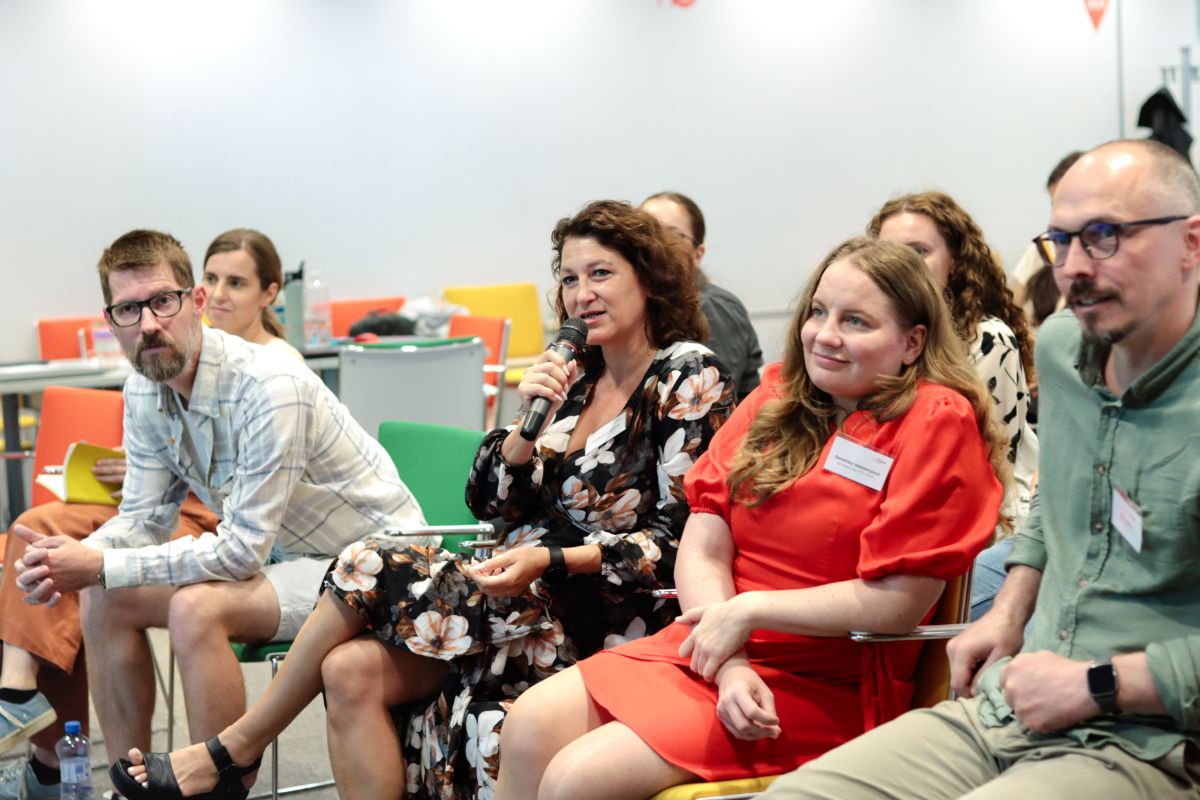
The first hour is for sharing experiences from the sandbox. The facilitator structures the discussion around three levels: what the tool did well, where it failed, and how an ideal AI consultant should behave.
The second and third hours are teamwork on improving the tool. In groups, participants propose concrete changes to the system prompt, to the structure of the questions and to how the tool responds to superficial answers. The output is version 2.0 of the tool.
Note for facilitators: this workshop works as a design workshop, not as an evaluation of the tool. The facilitator has to actively hold the frame: participants evaluate the tool's behaviour, not its existence. The question is not whether the tool works, but what it has to change to work better.
Sandbox II — Working with version 2.0 (4 weeks)
The same structure as Sandbox I, but with the updated version of the tool. Participants can compare their experience with versions 1.0 and 2.0 and observe how changes to the tool affected the quality of the consultation.
Phase 3 — Synthesis and publication (3rd workshop, 3 hours)
The first hour is a final reflection: what has changed since the start of the programme, what participants are taking away, and what they would recommend to the next generation of participants.
The second and third hours are for building the final version of the tool and preparing its open source release. The output is version 3.0 of the tool and a short case study co-written by the participants.
5. Facilitation recommendations
Setting expectations before the programme
Before the first workshop, participants need to know that the programme includes productive frustration: moments when the tool does not work as they expect, or when their own thinking is not enough. This is not a flaw of the programme, it is a deliberate part of it. Without this disclaimer, frustration turns into disagreement instead of learning.
Cognitive load
The original programme design assumed that a participant would simultaneously be a user of the tool, a designer iterating it and a meta-observer of their own process. That is too many roles at once. Recommendation for replication: the meta-observer role is facilitated externally by the facilitator, not by the participant. Questions such as “what did you just realise about your own thinking?” are asked by the facilitator during group reflection, not given as an individual task while working with the tool.
Technical readiness
Before every workshop, test that the tool works in the environment where it will be used. A technical outage during group work significantly affects the experience and the evaluations. Have a backup scenario ready, for example individual work on laptops if the group demonstration fails.
Measuring results
NPS, the likelihood of recommending the programme, is not a suitable metric for experimental education of this kind. The programme deliberately includes moments of discomfort and confrontation with one's own assumptions. We recommend measuring learning outcomes directly: after the programme, can the participant formulate a specific critique of an AI output, can they propose a change to the system prompt and argue for it, and has the way they think about the impact of their project changed?
6. Outputs and evaluation
Individual outputs
A reflective note after each sandbox period. Not an evaluation of the tool, but a record of one's own learning: what I found out, what surprised me, what I would change.
Team outputs
A concrete, reasoned proposal for a change to the tool: what should change, why, and what it would improve.
Shared outputs
An improved version of the tool, iterated in the Lifbee programme up to version 3.0. An open source release on GitHub. A case study co-written by the participants.
Success criteria
The programme has succeeded if, at the end, participants can work critically with AI output, understand the basic architecture of the tool and can modify it, and if the collective iteration of the tool produces a measurable improvement between versions 1.0 and 3.0.
7. What we would do differently
This section captures lessons from the first run of the programme at Lifbee Academy, from November 2025 to March 2026. It is meant for anyone who wants to replicate the methodology.
Three roles at once do not work. The original design was too ambitious in what it asked of participants at the same time. In the next iteration, the meta-observer role would be separated and facilitated externally.
The frustration disclaimer belongs at the start. Participants who knew in advance that the programme included deliberate discomfort coped with it differently from those who discovered it unexpectedly. This is a simple change with a significant impact on the experience.
Technical stability is a precondition, not a detail. A tool outage during a group workshop affected the evaluation of the whole programme out of proportion to its severity. Technical readiness must be part of the facilitator's preparation just as much as content.
ESG as one dimension, not the centre of gravity. The original hypothesis assumed that ESG would be the main motivation for using the tool. Participants at the earliest stage of a project are primarily concerned with viability and the market. ESG remains an important dimension, especially in Life Sciences and EnviroTech, where environmental and social impacts are inseparable from the product, but it is not the entry point for working with the tool.
Evaluative mode works better than generative mode. A tool that produces analyses on the participant's behalf invites passive acceptance. A tool that challenges the participant's thinking invites active reflection. This is the key design decision for anyone who will develop or replicate the tool further.
The tool used in this methodology is available as open source on GitHub. Both the methodology and the tool are the result of a collaborative process in which the programme participants and the Lifbee Academy team learned side by side.
We thank the ČSOB Foundation for its grant support of the project.