Why in ten years one person will do what takes a whole team today
One full-stack developer once replaced a whole team. AI is now doing the same across fields, from biology to hardware. Judgement matters more than tools.
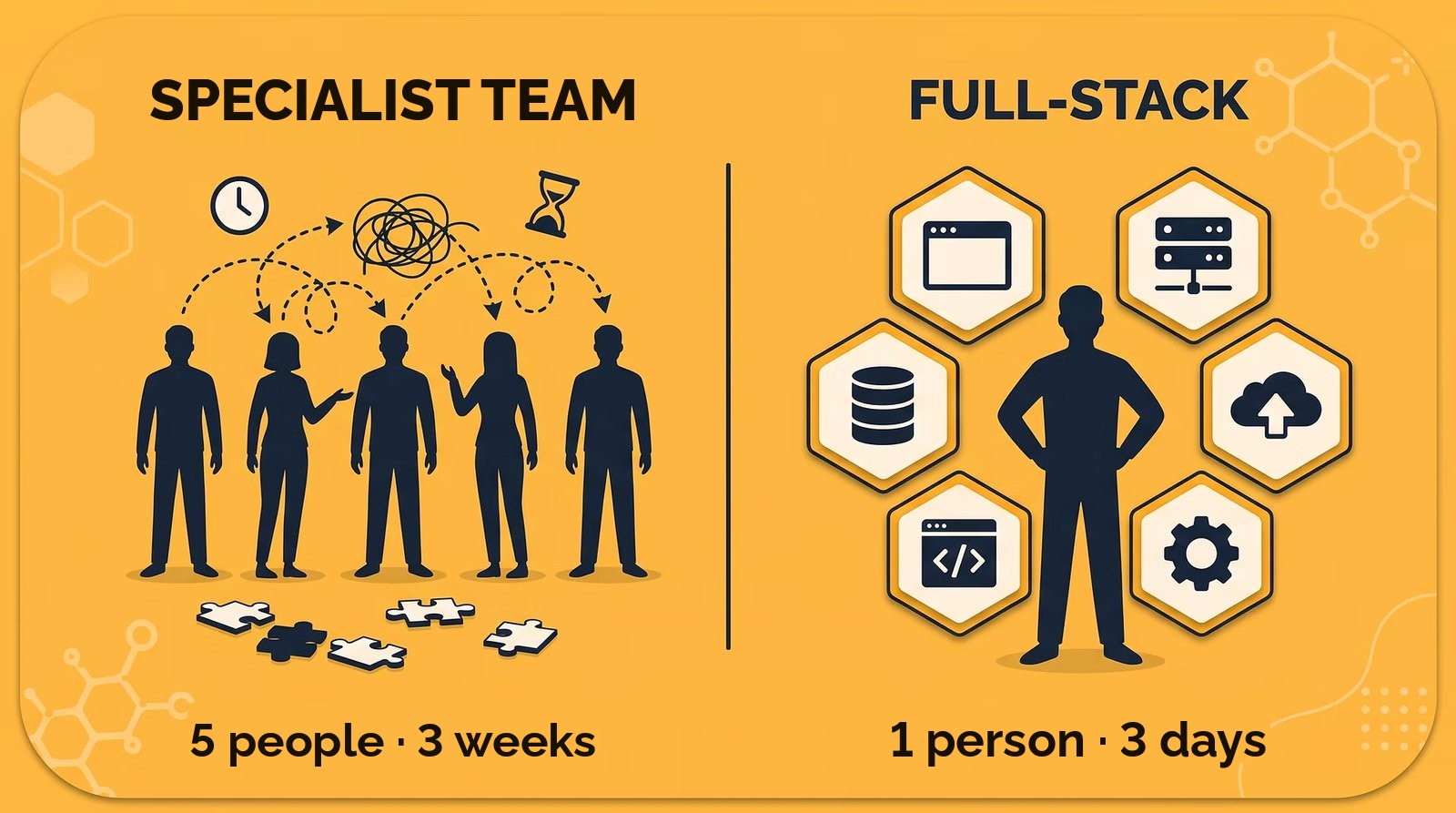
Imagine two companies working on the same task. One needs five people and three weeks. The other needs one person and three days. The results are comparable. Sometimes the one-person result is even better.
Ten years ago, this was happening in software. Now it is happening almost everywhere. And there is a good chance it will soon happen in your field too. Let's look at why, using concrete examples, and above all at what it means for you.
2012: the story of one login screen
Picture a startup in 2012. Let's call it Maply; they are building an app for sharing maps. A task comes in that sounds trivial: add email login with an option to reset a forgotten password.
The standard approach back then went like this. Lucia, a frontend developer, builds the login form. Tomáš, a backend developer, builds the part that checks passwords. To understand each other, they have to agree on the format in which they will exchange data. The database administrator adds a users table. Someone from operations deploys the whole thing to the server.
Each step waits for the previous one. Lucia cannot properly test the form until Tomáš has finished his piece. Tomáš finds out that Lucia is sending a field he does not expect, and they go back to negotiating. The whole thing takes two weeks. Not because it is two weeks of work, but because most of the time goes into waiting and coordinating between people.
Now picture Daniel. Daniel is a full-stack developer. He takes the whole task: the form, the verification, the database and the deployment. He does it in two days. Not because he is necessarily a better programmer than Lucia or Tomáš. He wins because he holds the entire system in his head at once. When something does not work, he sees where, because he knows every part. He does not have to hand anything over or wait for anyone.
In 2012, many people underestimated Daniel. A full-stack developer sounded like someone who knows a little of everything and nothing properly. Today, full-stack developers are completely standard.
What Daniel taught us
Daniel's advantage was not technical, it was a way of thinking. When one person holds the whole system, the time spent handing work between people disappears, misunderstandings about where responsibility ends disappear, and there is direct ownership of the result.
For a certain class of problems, especially new products and finding solutions quickly, one person with an overview is stronger than a team of specialists.
Today: the same thing is happening almost everywhere
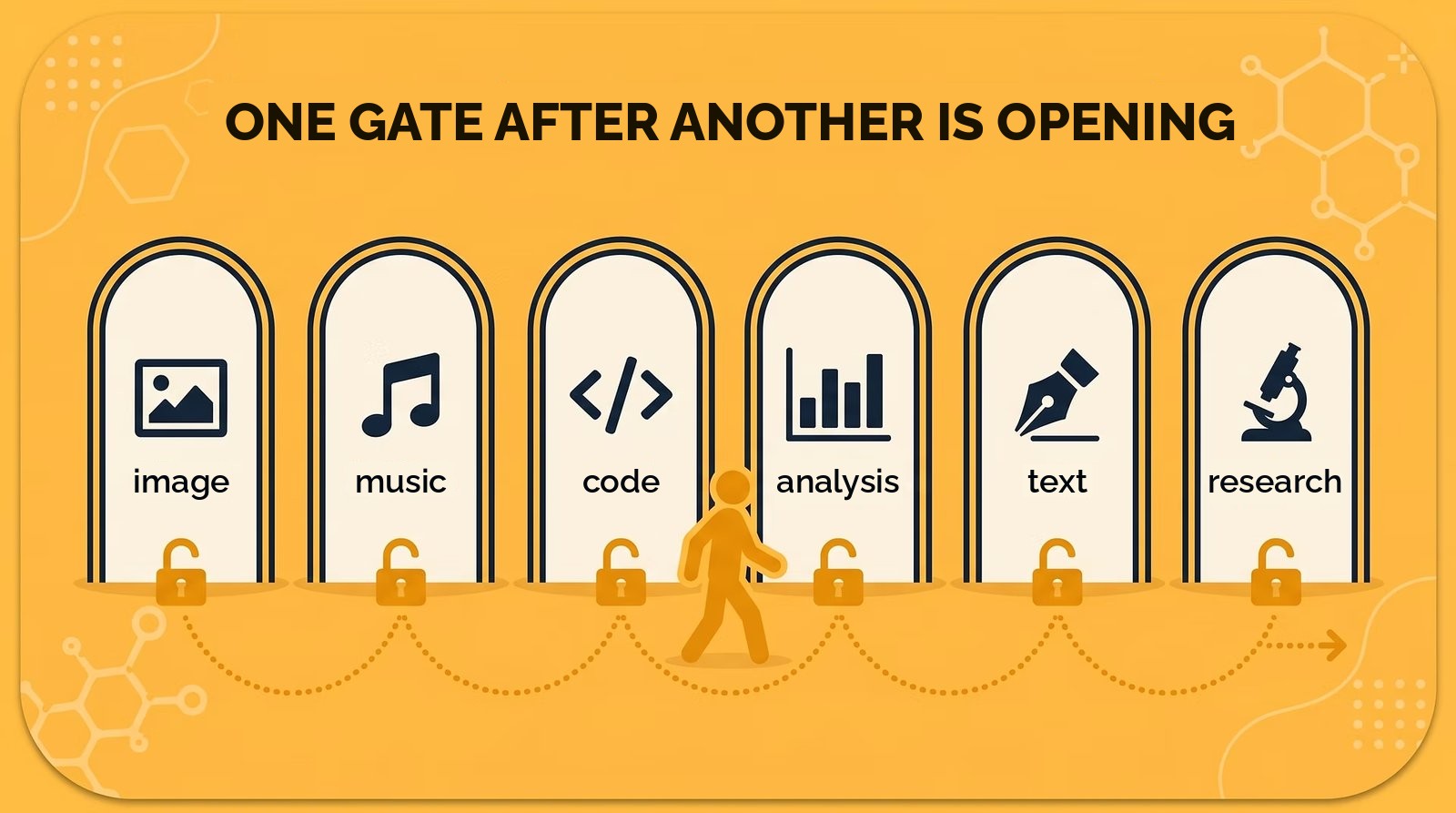
Until 2024, one unspoken rule applied. Every creative or professional field had its own gatekeeper at the entrance.
Want an image or a video? You need a designer or a video creative. Want music? A musician. Want an app? A programmer. Want to map a market? An analyst. Want copy that sells? A copywriter. Want to analyse scientific data or design a device? A researcher and an engineer.
And into all of this comes AI. AI has not abolished these professions. It did something different and far more interesting: it removed the entry gate. Suddenly one person with the right mindset can get into each of these fields. Not at the level of a world-class specialist, but at a level that is entirely enough for usable output.
And this is where a new profile is born. Someone who has genuinely connected this breadth together. Not as a list of apps open in their browser, but as one fluid ability to create across fields. Let's call them the full-stack AI hacker.
2026: the story of one discovery
Picture Nina. She is a young biologist with an idea: a bacterial strain that can turn cheap waste into a valuable substance. To find out whether it makes sense at all, she has to go through a long chain of steps.
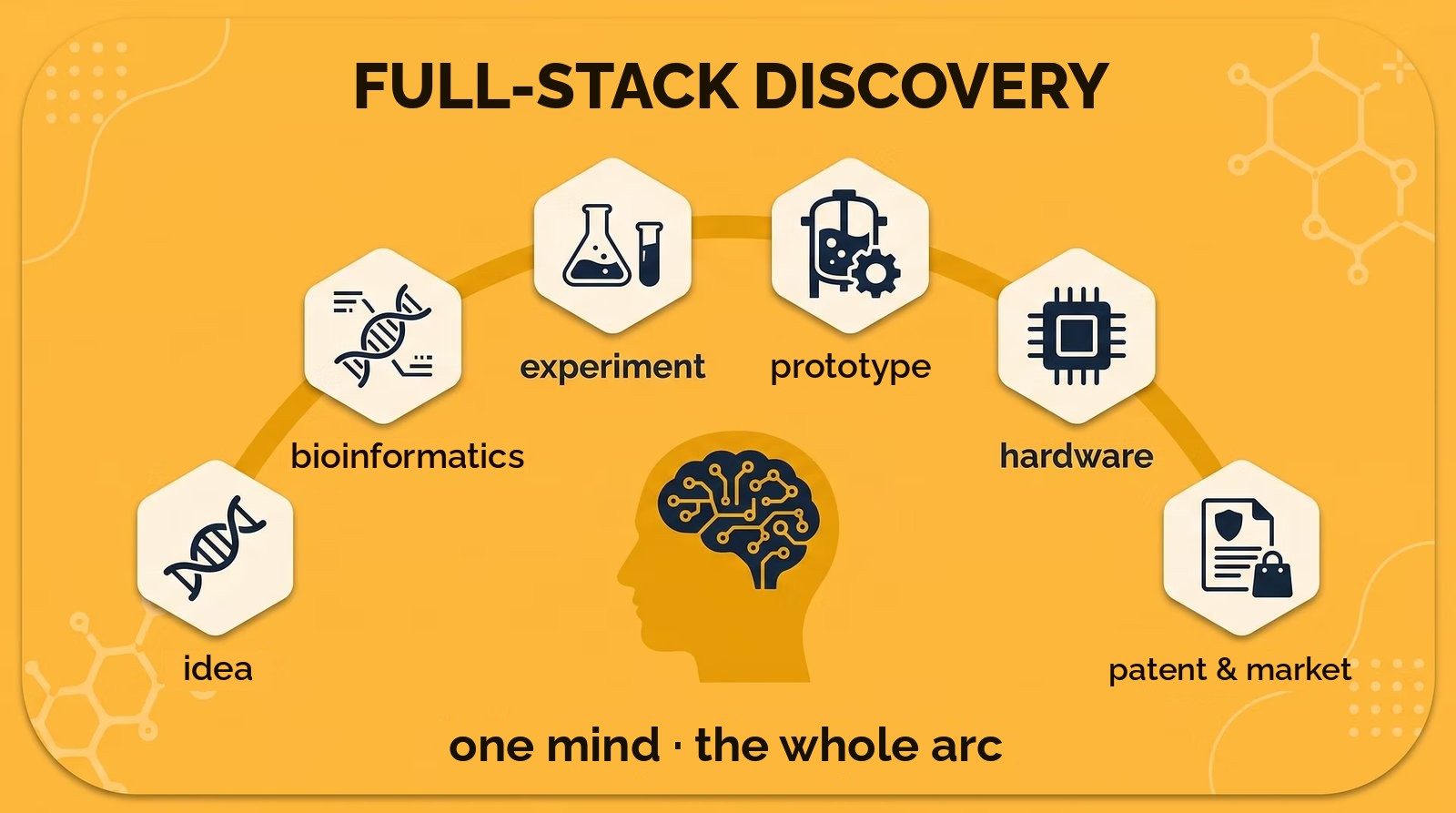
The standard approach looks like this. To analyse the genetic data she needs a bioinformatician. To design and evaluate experiments, a lab and time. To improve the bioreactor, the vessel in which the bacteria grow, she needs a mechanical engineer to design it in CAD. For the sensors and control systems, an electronics engineer. To protect the idea and check the regulations, a patent attorney. And only at the very end come the product, the website and the communication.
This is exactly where most ideas “die”. Not because they are bad, but because one person never gets through all those gates. Every gate is a different specialist, a different budget and more waiting.
Now picture the same Nina as a full-stack AI hacker. She handles the website, the copy, the logo and a short promo video for the product herself. That is almost commonplace today and everyone is talking about it. But she goes much further. She does the bioinformatics with AI tools. She designs the experiments and evaluates the data herself; the measurements still run in a real lab, but the path to them is an order of magnitude shorter. She designs the bioreactor improvement in CAD. She puts together the sensors and control electronics as hardware. She does the first patent and regulatory analysis herself too.
And this is the real turning point. Not that one person can handle business and marketing. The turning point is the full-stack discovery: one mind holds the whole arc, from the biological idea through a working prototype and hardware to legal protection and the market. Before, what decided things was access to ten specialists.
But, and this is the most important sentence in the whole article, Nina does not win because she has the tools. She wins because she knows which experiment is the one that matters, she can tell a real result from a convincing-looking one, and she holds the whole system in her head, just like Daniel once did. The tools shortened her path. Judgement told her which path to take.
The catch most people miss
This is where most articles about AI get stuck on the wrong conclusion. It goes like this: tools are getting cheaper and more accessible, so soon everyone will have this ability.
No. Here is the difference that decides everything.
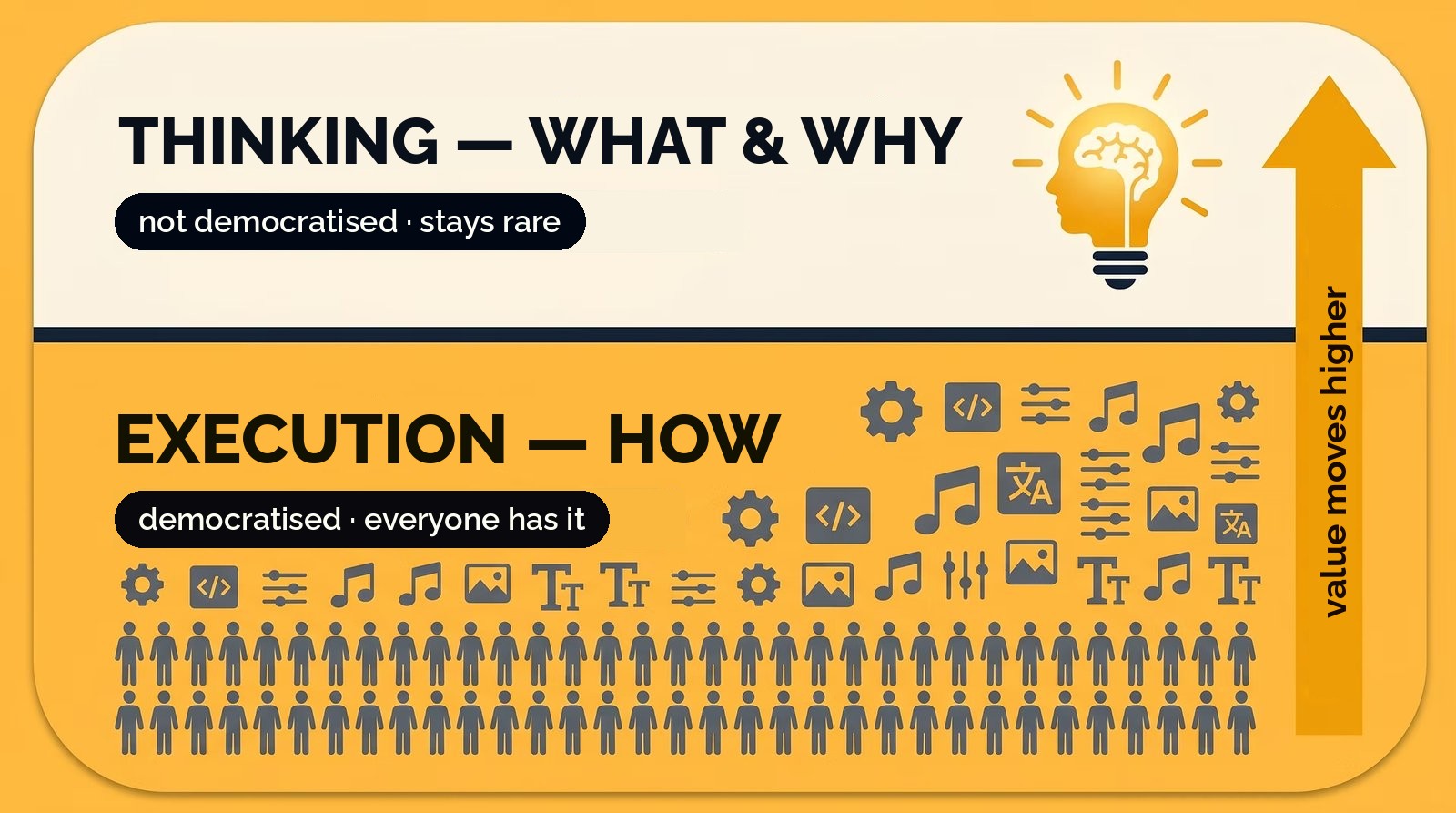
Execution is being democratised. Thinking is not.
Yes, you will have the same tools Nina has, and so will your competitors and your neighbour. But most people will use them differently. They will prompt faster without thinking about the problem. They will polish details and lose sight of the whole. They will produce more things without knowing which of them are worth anything.
A person without judgement and with a full AI arsenal does not create value. They create outputs that look finished on the outside but are empty inside. And the most dangerous part is that at first glance you cannot tell one from the other. The difference only shows when the consequences arrive.
That is why the full-stack AI hacker will stay rare, even when everyone has the tools. Value will move where it moves with every major technological shift: one layer up. To the question of what and why, not how.
So what does this mean for you
Now for what matters. What you should do about it.
If you are employed and your work is largely execution, such as preparing materials, first drafts and routine production, that part is becoming cheap right now. It is not a reason to panic, it is an early warning. The question to ask yourself is not “how do I get more done”. It is “which part of my work rests on judgement that cannot be prompted, and how do I build it”.
If you run a business or lead a team, the pressure will not be to get more people using AI. That will happen on its own. The pressure will be on something else: what you actually want from people when the tools handle the rest. The answer is decision-making under uncertainty that someone is accountable for. AI cannot do that, and will not be able to for a long time.
If you are studying or thinking about where to get your education, the classic advice to “specialise narrowly” is no longer the only truth. A combination will be more valuable: a solid foundation for thinking, such as mathematics, systems thinking and the ability to reason, plus practical breadth across AI tools. Depth in one thing will no longer sustain you on its own. Neither will breadth without depth. Their combination will.
So I am not just another prophet
I do not want to sell you a certainty I do not have. This line of thinking rests on several assumptions that could break.
If truly general, autonomous AI arrives sooner than we expect, the whole “human plus tools” logic changes. The question will no longer be what one capable person can do, but what humans do at all. It is also not certain whether one full-stack AI hacker can replace a whole team on genuinely complex problems that need several minds at once. And in fields such as biology or mathematics, it remains open whether AI delivers genuinely high-quality results, or only a convincing form of them.
I see this as a hypothesis, not a prophecy. But even if it is only half true, it is worth acting on today.
Conclusion
A full-stack AI hacker is not just someone who is good with apps. It is a new kind of creator. Thinking tells them what and why; AI tools tell them how and when.
Ten years ago we underestimated Daniel, and within a few years he became the standard. Now Nina is arriving. The difference is that the range of problems she can solve on her own is far larger than it used to be.
So the question is not whether this will happen. It is happening. The question is which side of this change you want to be on.
The author of this article is Matej Held, an expert in innovation in education and startups and co-founder of Lifbee.